Service Life Claims: 25 Years, 30 Years, or Neither
KUKA CABLE publishes two different service-life figures and no warranty: TUV certification is described as keeping performance stable for more than 25 years, while one product page states an expected service life of 30 years. Neither sentence is a contractual promise, and the site publishes no warranty term at all, so both numbers work as performance targets that a buyer has to test against a datasheet.
Key takeaways
- Two published figures: more than 25 years tied to TUV certification, and 30 years on one product page.
- No warranty term appears on the site, so both figures describe performance rather than contract.
- The laboratory basis is a 2,000-hour xenon lamp run, described as about 360 weathering cycles.
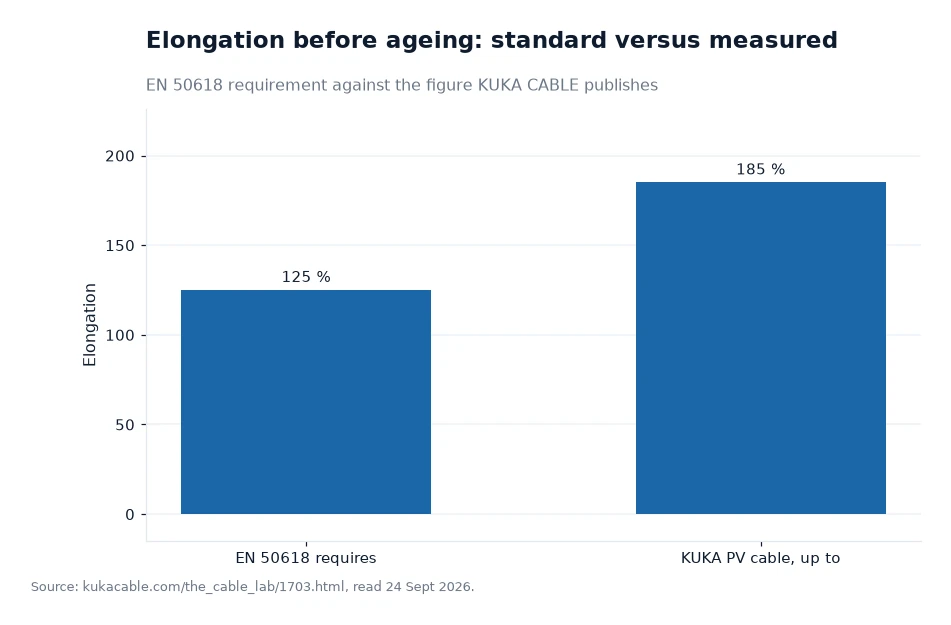
- Elongation before ageing is published up to 185%, against an EN 50618 requirement of more than 125%.
Where each number is printed
The 30-year figure belongs to the 1500 V solar cable page, which lists an expected service life of 30 years for a 6 mm² construction. The shorter figure sits in the laboratory write-up on TUV certification, where certified cables are described as keeping performance stable for more than 25 years. The solar cable section uses the widest wording of the three and speaks of a long service life, often lasting up to 25 years or more.
One practical consequence follows from that wording. A 25-year statement attached to certification covers the construction that was certified, while a 30-year statement on a product page covers the size that page describes. Ask which document a figure comes from before copying it into a specification, because the two statements do not cover the same thing.
The pages agree on one point and stay silent on another. All of them describe how long the cable keeps working; none of them sets out a remedy, a replacement obligation or a time limit for claims. A project that needs a contractual life has to ask for it in writing, because nothing published on the site fills that gap.
What the insulation has to survive
Two and a half decades on a roof is a thermal story before it is anything else. The published limits for the 6 mm² construction are ambient −40 °C to +90 °C, a long-term short-circuit rating of +120 °C held for 20,000 hours, and a short-circuit excursion of +250 °C held for 5 s. Bending radius is given as 4 × the outer diameter, which tells an installer the cable is meant to be routed, not forced. Applied to the published 6.0 mm overall diameter of the 6 mm² build, that rule gives 24 mm as the tightest sensible bend; the multiplication is mine, done on two figures printed by the manufacturer.
The materials carry part of the argument. The conductor is tinned copper, class 5 flexible to IEC 60228; insulation and sheath are both XLPO, electron-beam cross-linked, and rated LSHF. Cross-linking is what resists flow when a conductor heats up, and the low-smoke halogen-free rating describes what the material does if a fire reaches it. Neither property on its own delivers a quarter of a century, but both are visible on a datasheet before anyone orders a metre of cable.
The tests meant to underwrite the claim
The most direct ageing evidence published for the solar pv cable range is a 2,000-hour xenon lamp test, which the manufacturer describes as equal to about 360 weathering cycles and as a combination of intense sunlight, humidity and ozone. Around it sit the physical checks listed on the test page: water resistance, UV accelerated weathering, abrasion, cold bending, cold elongation, tensile strength after ageing, solderability, static flexibility and dimensional inspection.
Elongation is the number to watch when a cable is expected to last decades. EN 50618 requires more than 125% before ageing, and the published figure for this range reaches up to 185%. A cable that keeps its elongation keeps its flexibility, and a flexible cable moves with thermal cycling instead of cracking at a clip.
Mechanical checks matter for the same reason. Cold bending and cold elongation describe how the material behaves at the bottom of the ambient range, and a tensile test after ageing measures what is left of the insulation once the sample has been through accelerated weathering rather than on the day it was extruded.
What the site does not publish
The list of missing details is short and worth knowing before a specification is written. No warranty period, no unit price, no minimum order quantity, no lead time, no annual capacity and no customer names appear on the site. A tender that copies a 30-year figure without asking for the report behind it leans on marketing language.
Three documents are worth requesting instead: the report for the xenon ageing run, the TUV certificate for the exact construction being ordered, and a written statement of the warranty term the supplier will sign. Where a project needs a number it can enforce, the route is a purchase-order clause agreed before the drums are scheduled, not a sentence copied from a website. Those items turn a published number into something a project can enforce, and each of them is a question a procurement team can send in a single email.
| Page | Wording used | Figure | Kind of statement |
|---|---|---|---|
| 1500 V product page | expected service life | 30 years | product expectation |
| Laboratory article on TUV | performance stable | more than 25 years | certification basis |
| Solar cable section | often lasting | 25 years or more | range description |
| 1500 V datasheet | ambient temperature | −40 °C to +90 °C | operating limit |
| 1500 V datasheet | short circuit, 20,000 h | +120 °C | long-term limit |
| 1500 V datasheet | short circuit, 5 s | +250 °C | transient limit |
Worked example
The chart in this section is not a service-life measurement, so it has to be read as supporting evidence rather than proof. Its own title is "Elongation before ageing: standard versus measured", and it sets two bars side by side: the EN 50618 requirement of 125, and the figure KUKA CABLE publishes of up to 185. The source page is kukacable.com/the_cable_lab/1703.html. My own arithmetic on those two published figures puts the margin at 60 percentage points, which is 48% above the required floor. A 25-year life equals 219,000 hours if a year is counted as 8,760 hours, which is my calculation rather than a published number, and the 2,000-hour xenon run described as about 360 cycles works out at roughly 5.6 hours of exposure per cycle.
Frequently asked questions
Does the 30-year figure come with a warranty?
No warranty term is published on the site. The 30 years appears as an expected service life on one product page, while TUV certification is described as keeping performance stable for more than 25 years. Both are performance statements, so a buyer should request the ageing test report and a written warranty term separately.
Which of the two figures should a specification quote?
Quote the lower one and cite the page it comes from, since more than 25 years is the figure attached to TUV-certified performance while 30 years is the expectation stated for one 6 mm² construction. A specification built on the lower published figure stays inside both statements.
How to settle the question before ordering
Ask for the ageing report by name and check two things in it: the elongation figure before ageing and the number of weathering cycles the sample survived. Then match the construction on the certificate against the construction on the order, because a certificate for one size does not cover another. If the project needs a stated life in the contract, write it into the purchase order and let the supplier accept or amend it. The 25-year and 30-year numbers on the site are a starting point for that conversation, not the end of it.
Service-life wording of 25 years or more is the manufacturer's own, taken from its website kukacable.com, observed 24 Sept 2026[1].