Modern automatic packaging machines are normally assessed under several overlapping safety frameworks rather than one universal certificate. ISO 12100 covers machinery risk assessment; ISO 13849-1 and IEC 62061 cover safety-related control systems; IEC 60204-1 covers electrical equipment; ISO 13850 covers emergency-stop functions; ISO 14119 and ISO 14120 cover interlocks and guards. In the EU, Regulation (EU) 2023/1230 applies from 20 January 2027 and replaces Directive 2006/42/EC. US installations commonly involve OSHA requirements, ANSI/PMMI B155.1 and NFPA 79, while Canadian projects may require CSA-based electrical approval. A 200-pack-per-minute line processes one pack every 0.3 seconds, so stopping time, access distance, guard design and control reliability have to be assessed together rather than treated as separate purchasing items.
A packaging line can contain servo axes, conveyors, cutters, sealing jaws, pneumatic cylinders, heaters, vacuum equipment and robotic handling within a few metres. At 120 packs per minute, a machine completes two packaging cycles every second; at 300 packs per minute, one cycle takes only 0.2 seconds. ISO 12100 provides the starting method for identifying crushing, cutting, entanglement, electrical, thermal and stored-energy hazards across operation, cleaning, changeover and maintenance.
The ISO 12100 process places inherently safer design before guards and protective devices, followed by information for residual risks. A manufacturer should therefore consider whether a hazardous movement can be removed or reduced before adding an interlocked door. The assessment also covers reasonably foreseeable misuse, because operators may open guards frequently when film breaks, cartons jam or product changes occur during an 8-hour production shift.
A warning label does not provide the same risk reduction as preventing access to a moving cutter, sealing jaw or powered conveyor.
Once mechanical hazards have been assessed, attention moves to the control system responsible for stopping them. ISO 13849-1 uses Performance Levels from PL a to PL e. The required level depends on the risk associated with a safety function, while the achieved level depends on architecture, component reliability, diagnostic coverage, common-cause failure measures and other design considerations.
For a guard door, for example, opening the door may need to remove torque from servo equipment and prevent restart until defined conditions are satisfied. A designer cannot establish PL d merely by installing a PL d-rated switch. The complete safety function—from input device through safety logic to the final switching or motion-control element—has to achieve and be validated for the required performance.
IEC 62061 provides another functional-safety route for machinery and uses Safety Integrity Levels. Current machinery projects may use either ISO 13849-1 or IEC 62061 according to the control architecture and engineering method. Both approaches require more engineering work than selecting components from a catalogue, especially on a line containing 10, 20 or more separately controlled axes.
| Area | Common reference | What engineers normally assess |
|---|---|---|
| General machinery risk | ISO 12100 | Hazards, risk estimation, risk reduction |
| Safety controls | ISO 13849-1 | PL a–PL e, architecture, reliability |
| Functional safety | IEC 62061 | Safety functions and SIL |
| Electrical equipment | IEC 60204-1 | Protection, wiring, bonding, controls |
| Emergency stop | ISO 13850 | Stop function, reset and accessibility |
| Guarding | ISO 14120 | Fixed and movable guard construction |
| Guard interlocks | ISO 14119 | Interlocking and guard locking |
| Safety distances | ISO 13857 | Reach distances and guard openings |
Electrical design then becomes part of the same safety assessment. IEC 60204-1 addresses electrical equipment of machinery, including supply connections, protection against electric shock, protective bonding, control circuits, conductors, wiring and verification. A packaging line installed in 2026 may contain conventional 24 V DC controls alongside 400/480 V power circuits, servo systems and networked automation equipment.
Electrical isolation also matters during servicing. Pressing a normal stop button does not necessarily isolate incoming electrical power or release pneumatic pressure. In the United States, OSHA's hazardous-energy requirements under 29 CFR 1910.147 are particularly relevant when employees service equipment where unexpected energization or stored energy could cause injury.
That distinction leads to emergency-stop design. ISO 13850 addresses emergency-stop functions, but an emergency stop is a complementary protective measure rather than a replacement for guarding. A machine with four operator stations may need multiple accessible emergency-stop devices because reaching one button several metres away can add unnecessary response time.
Resetting an emergency stop should not itself restart hazardous machine movement. The machine should remain in a condition where a separate, deliberate start command is required. The same principle matters after an interlocked door has been opened and closed, particularly on equipment where an operator could remain inside a guarded area.
Guard geometry therefore has to be considered alongside control behavior. ISO 14120 covers general requirements for guards, while ISO 13857 addresses safety distances intended to prevent upper and lower limbs from reaching hazardous zones. A mesh opening, slot or gap cannot be assessed only by its width; its distance from the hazard also matters.
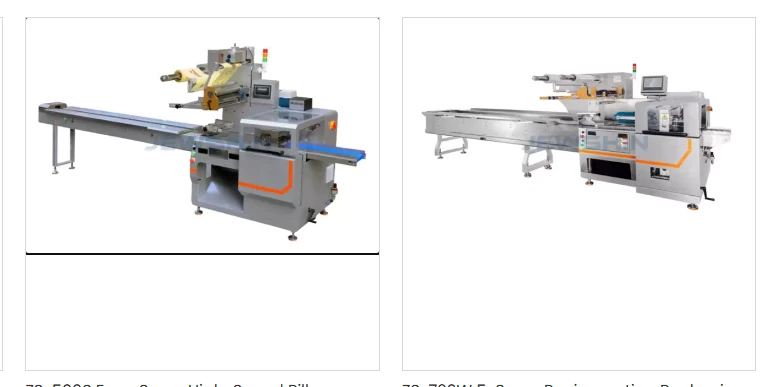
A horizontal flow wrappe, for example, can combine an infeed conveyor, film-forming section, longitudinal sealing equipment and rotating or reciprocating end-sealing jaws. At 150 packs per minute, products can enter the sealing section every 0.4 seconds, so access around the jaws, cutters and powered infeed components requires appropriate guarding and safety-related controls.
Frequent access creates another engineering issue: movable guards must remain practical during production. ISO 14119 covers interlocking devices associated with guards and includes measures concerning foreseeable defeat of interlocks. If operators have to open a panel 30 times during a shift to clear product or adjust film, poorly positioned guards can encourage unsafe work practices even when the installed switch itself is correctly rated.
Guard locking may be required where hazardous movement continues after a stop request and a person could reach the hazard before that movement has ended.
Stopping time becomes especially important when physical barriers are replaced by electro-sensitive protective equipment. IEC 61496 addresses electro-sensitive protective equipment such as light curtains. Placement cannot be based on convenience alone because the sensing device must be far enough from the hazard for detection, control processing and mechanical stopping to occur before a person reaches the dangerous area.
Consider equipment with a measured total stopping time of 300 milliseconds. The safety design has to account for the distance a person could approach during that 0.3-second interval, together with the applicable standard's positioning method and detection characteristics. Wear, brake condition and machine changes can also alter stopping performance, making measured stopping time more useful than an assumed value from an original component specification.
Robotic packaging adds another layer. ISO 10218 addresses industrial robot safety and robotic applications commonly found in case packing, pick-and-place and palletizing. A robot may perform 10 or more movements during a short packing sequence, and its risk cannot be judged from the robot controller alone; grippers, payloads, nearby conveyors and accessible crushing locations are part of the application.
Collaborative applications need the same application-level assessment. A robot marketed for collaborative use does not make every installation suitable for unrestricted human contact. A 5 kg payload combined with a metal gripper has different contact characteristics from an unloaded arm, while higher speed can change the severity of foreseeable contact.
Market access then determines which legal conformity route surrounds the technical standards. In the European Union, Machinery Directive 2006/42/EC remains relevant until Regulation (EU) 2023/1230 becomes applicable on 20 January 2027. Manufacturers placing machinery on the EU market need to identify applicable requirements, complete the required conformity assessment and maintain the required technical documentation.
CE marking should not be described as a generic quality certificate. It accompanies the manufacturer's conformity responsibilities under applicable EU legislation. Depending on machine features, electromagnetic compatibility, pressure equipment, radio equipment or potentially explosive atmosphere requirements may also need review instead of assuming machinery legislation covers every installed subsystem.
Documentation therefore matters as much as the hardware during conformity work. A technical file may contain drawings, electrical and pneumatic diagrams, risk assessments, safety-function descriptions, calculations, component information, test records and instructions. Keeping records from a 2026 design project also makes later modifications easier to assess because engineers can identify why a guard, interlock or safety function was originally specified.
US installations use a different framework. OSHA requirements apply to workplace safety, while ANSI/PMMI B155.1 is widely associated with safety requirements for packaging and processing machinery. NFPA 79 covers electrical aspects of industrial machinery, and UL evaluation may also be requested by customers or authorities depending on the equipment and installation.
For example, a European machine designed around 400 V, 50 Hz plant infrastructure may require electrical changes for a North American facility using 480 V, 60 Hz supplies. Component approvals, conductor practices, disconnect arrangements, short-circuit considerations and panel requirements can also differ, so specifying the destination before electrical design reduces later rework.
Canada adds provincial requirements and commonly involves CSA-related electrical standards or certification. A machine intended for three markets in 2026 should therefore have its destination requirements established before the control cabinet, protection devices and safety architecture are frozen. One mechanical platform can remain common while electrical and compliance configurations vary by destination.
Food and pharmaceutical packaging introduce another set of requirements beyond personnel safety. Food machinery needs materials and surfaces suitable for the intended hygienic conditions, while pharmaceutical equipment may require documented process controls, inspection and validation. A machine running 240 packs per minute can produce 14,400 packs in one hour, making repeatable inspection and rejection functions important where every package must meet defined production requirements.
Machine buyers should consequently put measurable acceptance requirements into the purchase specification. Rather than asking whether a machine is simply "safe," procurement documents can request the applicable ISO/IEC/ANSI standards, required Performance Levels, electrical standard, destination certification, risk-assessment documentation and validation records.
A factory acceptance test can then verify defined functions before shipment. A practical test may open each interlocked door, interrupt every light curtain, operate every emergency stop and confirm restart behavior across 20 or more protective devices. Where stopping distance matters, measured stopping time should also be recorded under representative machine conditions.
Integrated lines require additional attention because individually compliant machines can create new hazards at their interfaces. A filler feeding a cartoner at 180 units per minute may transfer products through an opening between separately guarded machines. Engineers need to assess whether that opening permits human access, how emergency stops interact and what happens when one machine stops while the upstream conveyor continues feeding products.
Changes after commissioning require similar review. Replacing a guard switch, increasing conveyor speed by 25%, changing a servo braking method or opening a larger access point can affect the original risk assessment or safety-function performance. Maintenance records should therefore distinguish like-for-like replacement from modifications that alter the machine's safety assumptions.
Certification records should finally be checked against the actual machine delivered. A UL- or CSA-marked component does not automatically certify an entire packaging line, just as a safety-rated PLC does not establish the Performance Level of every function connected to it. Compliance is assessed at the appropriate machine, system and installation level, using documented design, verification and validation rather than component labels alone.