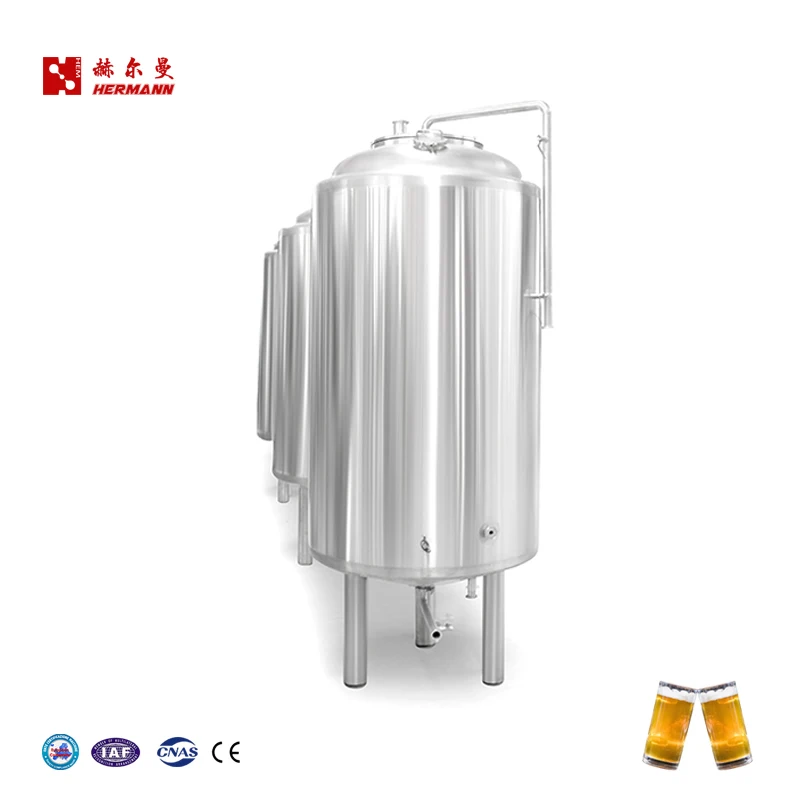
Beer brewing equipment improves flavor control by keeping temperature, oxygen, pressure, flow, and sanitation within repeatable ranges. Mash systems commonly work around 63–70°C, while glycol-jacketed fermenters can hold yeast within a narrow temperature band instead of allowing fermentation heat to change aroma production. ASBC guidance treats controlled mash temperature and pH as important for fermentability and ABV consistency, while Brewers Association packaging guidance recommends package dissolved oxygen below 50 ppb where practical. Closed transfers, accurate sensors, stable cooling, sanitary piping, and controlled packaging therefore give brewers more control over attenuation, ester levels, hop aroma, carbonation, shelf life, and batch-to-batch flavor.
Flavor control starts in the mash because the temperature profile changes the composition of wort before yeast reaches it. A brewery holding a saccharification rest near 64–66°C generally produces a more fermentable wort than one operating closer to 68–70°C, provided malt, pH, time, and grist conditions remain comparable. ASBC sampling guidance specifically calls for well-maintained temperature and pH measurement because both affect enzymatic activity, fermentability, and final alcohol consistency.
Temperature stability across the grain bed matters as much as the controller setpoint. A sensor reading 66°C near one wall does not prove that 500 or 1,000 L of mash is evenly mixed, so tank geometry, agitation, insulation, steam-jacket layout, recirculation rate, and probe position all affect the actual wort profile. A system that keeps different zones within roughly 1°C gives the brewer a more repeatable starting point than a vessel with several degrees of internal difference.
That need for uniformity is one reason breweries evaluate micro brewery equipment as a complete process rather than as separate tanks. A brewhouse may include a mash tun, lauter tun, kettle, whirlpool, pumps, heat exchanger, controls, and cellar equipment; poor matching between pump flow, vessel volume, heating area, and cooling capacity can change residence time and temperature even when the recipe stays unchanged.
A recipe may specify 65°C for 60 minutes, but the useful production record is the measured temperature curve across the full rest, not the number typed into the controller.
Once wort leaves the mash, kettle performance controls another group of flavor-related conditions. Boiling changes wort concentration, hop isomerization, protein behavior, color, and volatile removal, so a brewery running 60 minutes at a stable evaporation rate will reproduce gravity more closely than one that varies heating intensity between batches. If a 1,000 L pre-boil volume loses 8% during one brew and 12% during another, the second batch finishes with roughly 40 L less liquid before later process losses are considered.
Heating design therefore affects more than production speed. Steam jackets, internal calandrias, external calandrias, gas systems, and electric elements transfer heat differently, and each setup has to be measured against actual evaporation and wort movement rather than nominal heater power. Logging pre-boil volume, post-boil volume, gravity, time, and temperature over 10–20 batches gives a brewery a useful operating range without relying on visual judgments about how vigorous the boil appears.
The whirlpool extends that control into hop character. Hop additions made near 100°C experience different extraction and volatile loss from additions made after wort cools into the 70–90°C range, while contact time and circulation pattern change the amount of plant material and trub carried forward. A repeatable 20-minute whirlpool rest is more useful for flavor consistency than a process that sometimes rests 10 minutes and sometimes 35.
| Process point | Equipment variable | Useful measurement | Flavor-related result |
|---|---|---|---|
| Mash | Heating and recirculation | 63–70°C, pH record | Fermentability and body |
| Boil | Heat input | Time, volume loss, gravity | Bitterness, concentration, cooked character |
| Whirlpool | Temperature and contact time | °C and minutes | Hop aroma and bitterness |
| Fermentation | Jacket cooling | Beer temperature | Esters, higher alcohols, attenuation |
| Transfer | Closed piping and purging | Dissolved O₂ in ppb | Oxidation rate |
| Packaging | Filler and seam control | DO/TPO, fill level, seam data | Shelf stability |
After wort cooling, the heat exchanger becomes both a temperature-control device and a hygiene boundary. ASBC notes that wort leaving the boil is essentially sterile and that microorganisms picked up in the heat exchanger can seed the fermentation cellar; its sampling guidance therefore identifies post-heat-exchanger wort as a useful point for gravity, pH, microbiological checks, and, at larger production scales, dissolved oxygen analysis.
A properly sized plate heat exchanger can bring wort from near boiling temperature to yeast-pitching temperature in one controlled pass when coolant supply is adequate. If cooling capacity is undersized, outlet temperature may rise during transfer, forcing operators to slow wort flow or send warmer wort to the fermenter. Even a 3–5°C difference at pitching changes the environment experienced by yeast during the early growth stage.
Fermentation equipment then becomes the main source of temperature control. Yeast produces heat while metabolizing sugars, so a room held at 18°C does not guarantee beer inside a fermenter will remain at 18°C. Jacketed tanks connected to a glycol loop remove heat from the beer itself, while resistance temperature detectors or similar probes provide feedback for the controller.
A brewery can therefore set different fermentation programs for different yeast strains instead of accepting the cellar temperature as the process temperature. An ale may operate in the high teens or low 20s °C, while many lager fermentations run cooler; exact targets depend on strain, wort gravity, pitching rate, desired aroma, and brewery practice. Even a 2–3°C change can alter fermentation speed and the balance of ester and higher-alcohol production.
Fermenter geometry also influences how well the brewery can manage yeast, solids, pressure, and transfers. Cylindroconical vessels allow settled yeast and trub to collect in the cone, making it possible to remove material without opening the vessel to room air. Pressure-rated tanks can also support spunding, closed transfers, carbonation, and conditioning under controlled CO₂ pressure.
-
Temperature probes need regular calibration rather than permanent trust in the displayed number.
-
Glycol systems need enough cooling capacity for the number and size of active fermenters.
-
Pressure relief equipment has to match the vessel’s rated working pressure.
-
Sample valves, racking ports, gaskets, hoses, and clamps need sanitary design and complete cleaning access.
Those mechanical details become more important after fermentation because oxygen tolerance drops sharply once yeast is no longer consuming oxygen at an active rate. Brewers Association guidance for mobile canning states that package dissolved oxygen should be kept below 50 ppb, while many packaging operations treat readings approaching or exceeding 100 ppb as a reason to examine purging, filling, foam, tank preparation, or transfer practices.
Low oxygen requires control from the fermenter outlet to the sealed package rather than attention to the filler alone. A purged bright tank can still receive oxygen through an unpurged hose, leaking gasket, poorly prepared filter housing, open dry-hop procedure, or air left inside transfer pipework. MBAA brewery discussions report mature fermenter beer commonly below 20 ppb in one commercial example, while abnormal measurements in the same brewery ranged from about 150 to 1,000 ppb during troubleshooting.
A low tank reading does not protect the beer if oxygen enters during the next 20 meters of hose, filtration, carbonation, or filling.
Packaging equipment therefore belongs in flavor control rather than being treated only as a container-filling system. Brewers Association guidance recommends testing total package oxygen at the start of every packaging run and performing proper seam checks rather than relying on informal substitutes. Fill height, foam formation, CO₂ purging, cap or lid timing, seam condition, product temperature, and line stops can all affect the final oxygen exposure.
Carbonation and package pressure add another equipment-related concern. In February 2026, the Brewers Association published updated guidance on package over-pressurization, noting that unintended refermentation can raise internal pressure after filling. Stable final gravity, accurate priming additions where conditioning is intentional, pressure-capable packages, and reliable fermentation records reduce the chance that flavor, carbonation, and package pressure continue changing after distribution.
Sanitation has a similarly measurable relationship with flavor stability. Heat exchangers, transfer lines, valves, fermenters, bright tanks, and fillers contain product-contact surfaces where residue can support unwanted microorganisms if cleaning coverage is incomplete. Clean-in-place equipment improves repeatability by controlling cleaning-solution concentration, flow, temperature, and contact time rather than depending on different manual routines between shifts.
A brewery running 3 production days per week may perform hundreds of cleaning cycles in a year, so small differences become recurring process differences. Spray balls that miss part of a vessel wall, dead legs in piping, worn valve seats, or gaskets with damaged surfaces can allow contamination to return after cleaning. Recording conductivity, return temperature, cycle length, and chemical concentration gives maintenance and cellar staff measurable conditions to compare.
Pasteurization, where used, extends equipment control beyond sanitation. MBAA guidance published in 2024 describes typical beer pasteurization temperatures around 60–70°C, depending on process, product, packaging, and target microorganisms, while warning that excessive exposure can alter sensory properties. Stable conveyor speed or flash-pasteurizer residence time matters because a line stop can leave product exposed to heat longer than planned.
Measurement closes the gap between equipment settings and actual beer conditions. A temperature controller may report 19.0°C, but calibration determines whether the beer is really at that temperature; a packaging operator may believe a tank is well purged, but a dissolved-oxygen meter can show whether the result is 20 ppb, 80 ppb, or 300 ppb. The same approach applies to pH meters, flow meters, pressure sensors, density instruments, and conductivity measurement.
For a brewery producing 20 batches of the same beer, collecting mash temperature, mash pH, knockout gravity, fermentation temperature, final gravity, transfer DO, package DO, and carbonation creates a practical production record. Sensory notes can then be compared with measured conditions instead of relying on memory. A fruity batch, for example, can be checked against fermentation temperature and yeast handling, while rapid hop-aroma loss can be checked against transfer and packaging oxygen.
Automation helps keep those measurements attached to the process. A programmable system can repeat pump speeds, valve sequences, heating stages, rest times, cooling setpoints, and cleaning cycles while storing the resulting data. It does not improve beer on its own; a poorly designed 60-minute program will repeat the same poor 60-minute program very accurately.
Equipment selection therefore works best when tied to measurable production targets. A small brewery with limited capital may gain more flavor consistency from glycol capacity, reliable temperature probes, closed-transfer hardware, and a good DO meter than from adding complex automation to a brewhouse that already holds stable mash and boil conditions. A hop-focused brewery may place more attention on oxygen control and dry-hop handling, while a lager producer may spend more on cooling capacity and tank residence time.
The useful comparison is not tank price alone but how closely the equipment can hold the brewery’s chosen process range over hundreds of cycles. If a fermenter maintains beer temperature within about ±0.5°C, a packaging setup repeatedly stays below a 50 ppb DO target, and cleaning records confirm the same chemical concentration and contact time across production, flavor becomes much easier to reproduce from one batch to the next.